Philosophy of Online Teaching & Mentoring
Introduction: The Pedagogy of Possibilities
Drawing on an early career as an investigative journalist, twelve years of teaching in higher education, and over twenty years as a social entrepreneur and executive producer of award-winning digital learning games, I design and deliver technology-enabled curricula that bridge the gap between abstract concepts and real-world application. My teaching philosophy is driven by a pedagogy of possibilities; a commitment to approaching every challenge by asking “why” and encouraging students to envision “what could be.” I utilize Design Thinking and Game-Based Learning (GBL) approaches to shift students from passive learners to active, adaptive thinkers with the confidence to uncover root causes, identify leverage points, and translate insight into action.
Guiding Principles for Online Teaching & Mentoring
Design Thinking
Solving Beyond the “Level of the Problem”

I teach my students that you cannot solve a problem at the level of the problem; you must look underneath, above, and sideways - and talk to the people experiencing the problem - to uncover root causes that are often not discoverable from a purely rational or top-down perspective. In my health and environmental classes, students follow the Design Thinking process to Define a problem they select in their community or on campus, uncover who is impacted, how, and why through an Empathy process, Ideate solutions, design a Prototype, and develop a plan for testing and engaging partners and collaborators. Throughout the process, I encourage students to “fail” and “try again” at any point. In most cases, this gives students permission to take risks and innovate.
-
The Define Stage: Students utilize the 5 Whys and Ishikawa (Fishbone) diagrams to move past symptoms and name the intersecting sectors, such as gender norms, economic pressures, or policy, that drive a challenge. They begin with existing facts, information, and data to understand the problem, then use analytic tools that reveal patterns, themes, and overlaps.
-
The Empathy Stage: Based on foundational knowledge developed through research and source evaluation using a CRAAP test (Currency, Relevance, Authority, Accuracy, and Purpose), students interview people impacted by the problem and distill insights that sharpen their understanding of lived experience. Students also create stakeholder maps to clarify who can enable or block solutions, making visible the ecosystem of influence, incentives, and constraints.
-
The Ideation Stage: After approximately 6–8 weeks of exploring underlying causes and systemic relationships, students pose a “how might we” question, brainstorm multiple solutions, and then return to impacted communities and relevant stakeholders for feedback. Students refine, revise, or pivot entirely when new insights reveal a more strategic leverage point.
-
The Prototype Stage: Students develop a prototype, often a product or service, supported by clear visual or descriptive explanations of what it is, how it works, and how it emerged from the full process. While students do not test the prototype in real time, they are asked to quantify intended impact, define plausible indicators of success, and articulate how implementation could occur through partners and an execution plan. Students present the full Design Thinking arc through a culminating pitch that functions like a Shark Tank-style assessment, evaluated on how human-centered inquiry and evidence informed the solution pathway.
-
Case Studies: Throughout the semester, students engage complementary readings and multimodal materials including videos and podcasts. I also use case studies from my own global health work to demonstrate how human-centered design shifts interventions toward leverage points. One example is my work for the Bill & Melinda Gates Foundation in Ethiopia on malnutrition among infants and young children. While the rational solution was “educating” mothers, research revealed that mothers were constrained by husbands who sold recommended chickens and eggs at the market and by mothers-in-law who pressured early introduction of water and sugar rather than exclusive breastfeeding. By targeting these influencers, the “Other than Mothers” approach, we addressed systemic barriers rather than individualizing responsibility.
Game-Based Learning
Navigating Leadership Challenges
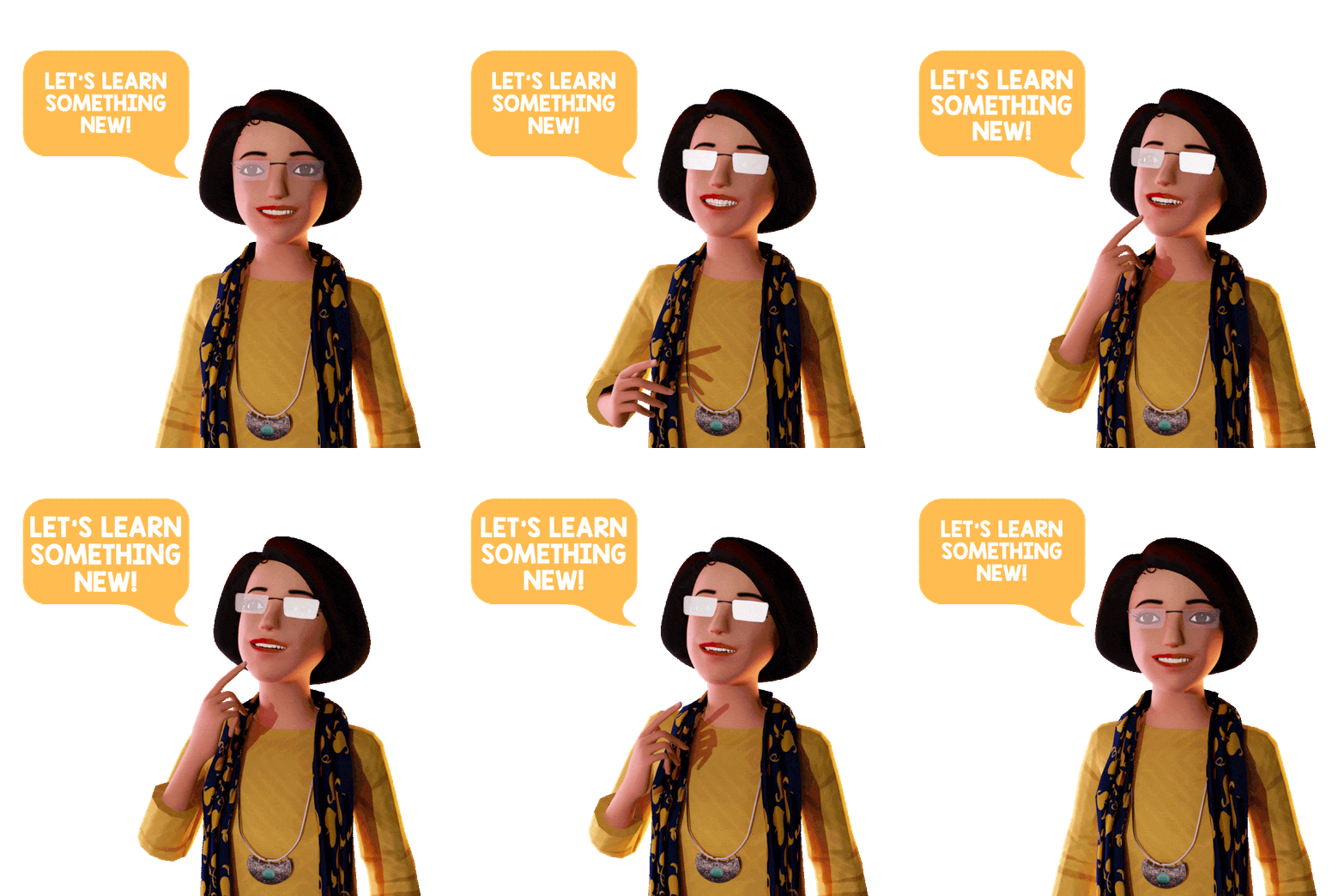
Dr. Paro, mentor character in Go Nisha Go
Leadership is a dynamic practice best mastered through Game-Based Learning (GBL), which mirrors real life by requiring choices under constraints and making consequences visible.
-
Immersive Scenarios: My INTS 204 Leadership course requires students to create their own game content each week based on a case study from the assigned reading. The game mechanics draw on the Cards Against Humanity format: students define the leadership scenario (Black Card) and create three theory-grounded choice options (White Cards). For each White Card option, students must explicitly root their decision logic in theories or frameworks from the text.
-
AI Integration (a deliberate shift in my online pedagogy): My approach to AI in the online classroom has evolved substantially. I moved from prohibiting AI, primarily out of concern for authenticity and shallow completion, to requiring and structuring its use as an object of critical analysis. Students use AI to forecast plausible consequences of their White Card leadership choices, then evaluate and critique AI-generated responses through the lens of leadership theory. In this format, AI is not a substitute for thinking; it becomes material for theoretical interrogation. Students must surface where AI reasoning is simplistic, misaligned with course concepts, inattentive to power dynamics, or ethically naive, and revise accordingly. This shift represents a significant change in my practice as an online educator: I now teach AI literacy as a component of academic integrity and professional readiness, emphasizing transparency, judgment, and theory-based evaluation.
-
Escape Room Mini-Challenges and Finale: In addition to the Cards Against Humanity-style game, students create Escape Room mini-challenges that require them to define the leadership dilemma and the guardrails, such as equity, trust, or morale, that must be protected in decision-making. These mini-games culminate in an Escape Room Finale, which functions as the final assessment.
Escape Room Finale (Culminating Assessment): The final project builds directly from the first-week’s “sensemaking” assignment in which students describe a real leadership challenge from their own lives - one that did not unfold as they hoped or that they would handle differently in retrospect. Near the end of the semester, students revisit the same sensemaking questions to document how course theories have reshaped their interpretation of the situation. They then translate that lived experience into an Escape Room branching narrative - mapping the context, stakeholders (“players”), decision points, guardrails (e.g., equity, trust, well-being), and evidence checks - to simulate how different post-midterm leadership theories would generate different choices and outcomes. This sequence creates a visible arc of learning: students move from baseline reflection to theory-informed judgment, demonstrating transfer from course concepts to real-world leadership practice.

INTS 204 - Leadership Theory & Practice
Student artifact from final escape room challenge
Decision slide
Multi-Modal Design
Instruction, Creation, Collaboration, and Multimodal Prototyping

INTS 249 - Digital Literacy - Sample student artifacts including podcasts, text-based games, data visualization, 3D video prototypes, AR/VR and use of AI for animation
In my courses, multimodality is not simply “varied media.” It is an end-to-end design strategy: I use multimodal tools to deliver learning, to help students create analytic and design artifacts, to support how students communicate and collaborate, and - critically - to enable students to prototype solutions in multimodal forms aligned to audience, context, and constraints.
-
Multimodality for instruction and engagement (how I deliver the course): I teach through a structured mix of short videos, podcasts, films, and interactive self-assessment or exploration tools (e.g., StrengthsFinder-type assessments, footprint maps). These modalities provide multiple entry points, evidence, narrative, and reflection, while supporting diverse learning preferences and reducing barriers to comprehension.
-
Multimodality for student creation (how students make thinking visible): Students use visual and systems-oriented tools to externalize reasoning and make causal logic explicit. They build diagrams and models using Canva-style templates, causal mapping tools, and collaborative whiteboard environments (e.g., Miro-type boards) to produce fishbones, journey maps, stakeholder maps, and prototype storyboards.
-
Multimodality for collaboration and project management (how teams coordinate and stay accountable): Collaboration is treated as a teachable skill rather than an assumed competency. I structure peer feedback, role clarity, and iteration cycles through online discussion spaces (historically including Slack- and Signal-style channels and, more recently, Canvas Discussions). For group projects, students complete a Teaming Agreement to set expectations, assign responsibilities based on strengths, and establish a conflict-resolution pathway, with self- and peer-assessment checkpoints that document contribution. I also introduce a range of project-management and coordination tools (e.g., Asana-, Basecamp-, and Milanote-style platforms) so teams can select workflows that fit their needs while keeping tasks, deadlines, and deliverables transparent.
-
Multimodality as the solution (how students prototype interventions): Students do not only learn through multimodal resources; they also design multimodal products as solutions. Final student created prototypes may take the form of AR/VR experiences (e.g., tools to support PTSD-related design challenges, a campus ‘virtual’ fitness challenge), podcasts crafted to communicate intergenerational trauma to specific audiences, games that surface lived dilemmas (e.g., “parental expectations of success”), or app concepts that support everyday decision-making (e.g., quick-glance tools that help students align nutrition preferences with options in the GMU food court).
-
Technology as a solution under constraints (modeling fit, not novelty): To reinforce that modality and tool selection must match context and equity, I share applied examples from my work in Pakistan on behalf of the International Rescue Committee, where identifying women’s mobility constraints informed the design of an IVR phone-based service (developed with a telecom partner) that delivered health advice directly to women at home. This example helps students distinguish between using technology because it is “new” versus using it because it is the most accessible, context-appropriate option.
Mentoring Approach
Taking “Possibilities” to Scale
My mentoring philosophy is focused on building student agency and professional confidence by helping learners recognize, articulate, and advance possibilities - credible opportunities for change grounded in evidence, stakeholder insight, and practical constraints. I view my role as a steward of student potential and a design-thinking coach, working individually with learners to move prototypes from the virtual classroom toward community adoption, institutional uptake, or market viability.
Mentoring for Social Innovation
I worked with a student to seek funding and approval for the implementation of her prototype for a Horizon Hall rooftop garden, during its construction phase. I worked with her to develop an architectural mockup and an interdisciplinary implementation concept that engaged multiple colleges, from College of Public Health to the School of Business, linking to a Rooftop Garden Course with Supporting Curriculum.

INTS 210 - Sustainable World
Student artifact to create a rooftop garden on horizon hall with accompanying university-wide curriculum
Mentoring for Entrepreneurship
I supported a student (a Fairfax police officer) in advancing his “Ready Balm” prototype from concept to market. Sharing with me that he was inspired by my global partnerships experience, he collaborated with beekeepers in Tanzania to develop a beeswax-based healing lip balm for first responders; the product is now mass-produced and sold through Amazon.

Mentored former student to take design thinking prototype to market
Mentoring for Career Pathways and Applied Innovation
One sophomore developed a prototype for a hammock rental system using an automated QR code. His prototype addressed the problem of commuter students having nowhere to rest on campus between classes, other than their cars. By applying design-thinking skills from my course, he excelled at a Harvard hackathon, secured an internship in London, and was subsequently hired before starting his junior year by a tech firm in San Francisco as an engineer.

End of semester in-person meeting of INTS 410 online class to showcase final prototypes
Mentoring for Service Design
I currently mentor students in implementing service-based possibilities identified through design research, including law-office-based engagement supports for children of divorced parents and specialized caregiving services for children whose parents are attending court proceedings.
Mentoring for Global Innovation and Youth Engagement
I am currently mentoring a PhD student, as his doctoral committee chair, who is researching smart agriculture techniques to engage youth in India and support the continuity of farming livelihoods and practices. This mentorship focuses on translating emerging ag-tech possibilities into youth-centered engagement strategies that are culturally grounded, operationally feasible, and responsive to local constraints.
Growth as an Online Educator
From “Who” to “Why” (and Now to “What If” with AI)

Artifacts from the Loop Trail Quest - choice-based simulation research
My career began as an investigative broadcast journalist, where I uncovered the who, what, where, when, and why of community challenges. Recognizing that health issues were rooted in social determinants, I pursued an MPH to understand the “what” (symptoms) and “how” (risk behaviors), but as an entrepreneur, I pivoted toward the “why,” “what if,” and “what else.”
My journey into game design was inspired by volunteering at a national park during the Zika and Lyme outbreaks; I realized that explaining complex triggers and feedback loops was best achieved through simulation. This led to The Loop Trail Quest, a choice-based simulation built by GMU students that became the foundation for global grant-funded narrative games, and my PhD research. Over time, and especially as online learning environments and generative AI have reshaped student work, I have moved from a deliverer of content to a curator of experiences. My own online teaching has undergone a decisive shift: rather than positioning AI as a threat to learning, I now design structured, theory-driven activities that require students to use AI transparently and critically, strengthening judgment, ethics, and analytical rigor. In short, my online pedagogy has become more explicit, more scaffolded, and more committed to helping students practice the tools, and the discernment, they will need beyond the classroom.