Acknowledgements
I do not take for granted how many people have helped me become the educator I am, especially as my teaching has moved from paper-heavy, face-to-face routines into fully online course design grounded in design thinking and game-based learning. This section credits the collaborators and mentors who shaped that evolution, and it also clarifies what I have been responsible for in building and delivering my online courses.
Collaborators Who Helped Me Grow Into Online Teaching
Teri Ann Guingab (Instructional Design; George Mason University)
I started at Mason as an adjunct in 2013 with the College of Public Health without a dedicated office. I used to roll what looked like a carry-on suitcase to class. An instructional designer, Teri Ann Guingab, asked what was in the suitcase. I said, “papers.” That moment began a twelve-year relationship that changed my teaching life. Teri Ann helped me move from paper-based workflows to online course design. She taught me how to structure assignments, build clarity through rubrics, and make grading manageable. Over time, she helped me shift from simply posting materials online to designing online learning including scaffolding modules, building predictable rhythms, and creating courses that feel intentional and student-centered.
Jim McLean (Collaborative Learning Hub; Multimedia Support; Co-Teaching Partner)
My drive to make online learning immersive and creative led me to Jim McLean in the Collaborative Learning Hub. We first collaborated when I designed a final project for my Contemporary Health class where students produced a podcast. Jim taught the audio basics and production workflow, while I taught the content, framed the assignment, and evaluated student work for evidence, analysis, audience fit, and coherence. Over time, that collaboration expanded. Jim became a co-teaching partner in my synchronous Digital Literacy course, where we integrated AR/VR, AI, and multimedia production into the learning experience. Jim led the technical instruction and coaching on audio/video production, while I led the course design, taught the core content (digital literacy, ethics, and applied technology use), and managed assessment using rubrics and structured feedback.
A. Alonso Aguirre (One Health Mentorship and Research Framing)
Outside the classroom, some of my most important teaching questions have come from lived curiosity. While volunteering in a neighboring National Park to ensure that park visitors stay on the marked trail, take out trash, and keep their dogs on leash, I wondered: do visitors realize that behaviors like staying on trail, picking up litter, and keeping dogs on leash protect ecosystems and protect human health by reducing zoonotic disease risk? That question led me to A.Alonso Aguirre, a One Health expert at Mason at the time. In a 30-minute conversation, he pushed me to frame the idea as a research question and pursue a doctorate. And I did. As part of my doctorate, I designed a gamified research study, The Loop Trail Quest, that simulates park-based choices and makes causal relationships visible through decisions, trade-offs, and consequences.

Dr. Alonso Aguirre at Warner College of Natural Resources, Colorado State University
Partners Who Took a Risk on Games as a Public Health Learning Tool
Building on The Loop Trail Quest, I carried the same choice-based platform and design approach into my global health practice. In response to a USAID RFP focused on girls’ reproductive health in India, I wrote a proposal centered on choice-based decisions that explore how staying in school, delaying marriage, and navigating everyday constraints can shape health, opportunity, and household well-being. I am grateful to Erika Houghtaling and Mihira Karra, who took a risk on this early-stage innovation, which became Go Nisha Go and has been downloaded by more than 700,000 girls in India. Through USAID-supported work, we developed multiple games and conducted a randomized controlled trial that demonstrated effectiveness.
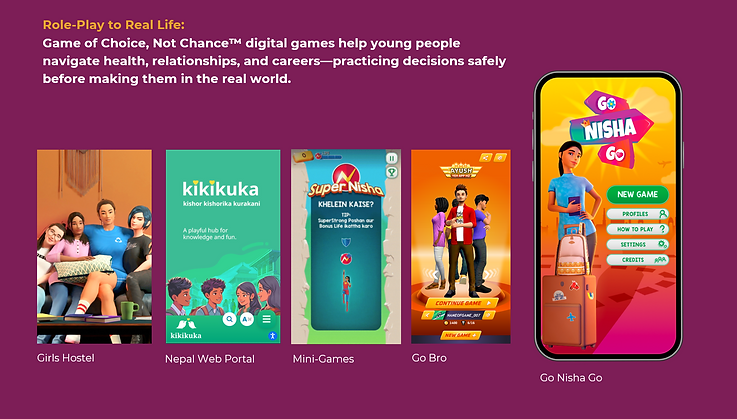
Game of Choice, Not Chance Suite of Games
Susan Howard - Executive Producer
Coming Full Circle: How Research in Serious Games Informs My Teaching
That arc - from a gamified research study to digital learning games for real-world decision-making - comes full circle in the classroom. I do not use games as entertainment or novelty. I use game-based learning as a way to make thinking visible and transferable: students translate theory into choices, anticipate consequences, reflect on trade-offs, and revise. Whether they are building a leadership branching narrative, designing a prototype, or creating a public-facing communication product, the structure of the work follows the same rhythm: challenge, evidence exploration and human-centered discovery, decision, consequence, feedback, iteration.
Course Design and Development Responsibilities
Across these collaborations, I have been the primary person responsible for building courses end-to-end: learning outcomes, module flow, scaffolding, assignment design, rubrics, feedback routines, and the overall student experience. I also mentor students through practice-oriented work helping them move from early “what if/what else” ideas to prototypes, pitches, and solutions that are grounded in evidence and real constraints.
My contributions to Mason’s curriculum include:
-
DSGN 101: Design Thinking (flagship course and Minor) I contributed to the design of the flagship Design Thinking course and minor, bringing my professional background in human-centered design and game design into assignment structure and applied learning outcomes.
-
INTS 410: Contemporary Health (Mason Core) I created Contemporary Health as a Mason Core course, designed to help students integrate scientific evidence with systems thinking and human-centered analysis of complex health challenges.
-
INTS 204: Leadership Theory and Practice I created Leadership Theory and Practice as the first fully online asynchronous version of the course, built around game-based learning (e.g., Cards Against Leadership and an Escape Room finale) to make leadership theory actionable through decisions and consequences.
-
INTS 249: Digital Literacy (redesign; synchronous) I redesigned Digital Literacy to incorporate emerging tools and ethical questions including AR/VR and AI and to treat multimedia production as a form of applied communication and digital practice.
I no longer teach INTS 249, Digital Literacy or DSGN 101 Design Thinking but rather integrate principles of design thinking and multimodal tools in all of my classes.
Personal Foundations

My Indian mother, Dr. Surya Howard, chose education over early marriage against societal and family expectations
Finally, I want to name a few personal foundations that shape how I teach and mentor. My father was a college professor who encouraged my entrepreneurial instincts and I know he would have been proud that I eventually followed him into the classroom. I also got to teach him a few things. I remember showing him how to check email, and in a phone conversation explaining how to cut-and-paste a Word document with a mouse, he paused and asked: “What is a mouse?” I still laugh when I think about it, but I also appreciate what the moment taught me: learning new tools can feel disorienting, even for brilliant people. It keeps me grounded when I design online courses by ensuring clear steps, low friction, and a lot of empathy.
My mother’s life story inspired Go Nisha Go: she delayed marriage, pursued her education, and became an innovator, discovering as a dental researcher the value of baking soda and peroxide. I carry both of my parents’ influence into my work with students. I see my role as one guide among many helping students learn how to ask better questions, take possibility seriously, and build the confidence to act on it.
The circumstances that led me to teaching fully online are bittersweet. My partner was diagnosed with a degenerative neurological disease and now requires 24/7 care. Moving my teaching online has allowed me to continue doing work I love while being present for her. I would never choose the diagnosis, but I am grateful that online teaching makes it possible for me to keep showing up for my students and for my partner at the same time.